Posts

THE POGROM: Reminiscence And Events That Bear Witness

Image
COMPILED AND EDITED BY AMBROSE EHIRIM "There are no exact numbers on the scale of the human tragedy gathering in Biafra. But all our sources do agree that more than a million people are likely to be in danger of starvation... There would be no question about evacuating the 5500 U.S. citizens or sacrificing the $300 million private investment on the Federal side if these stood in the way of relief. The heart of our dilemma, however, is that our instinctive moral concern and involvement with this tragedy cannot be separated from the political tangle..." --------- Henry A. Kissinger, Memorandum For President Richard Nixon, The White House, Tuesday, January 28, 1969 World's first super model, British-born Jean Shrimpton joins a group of anti-Igbo Pogrom protesters campaigning to end the killing of women and children on the steps of the Shaftsberry Memorial in Picadilly Circus, Westminster, London. Image: Hulton Archive/Getty Nurse Elva Peterson feeding sta...
BIAFRA: Church World Service At The Senate Foreign Relations Committee Hearing

Image
Image: United States Senate In his statement to the Senate Foreign Relations Committee, MacCracken explains the position of the CWS as it relates to the conflict and humanitarian crisis occurring in Biafra and Nigeria at large. He notes that the CWS is solely concerned with the humanitarian issues in Biafra and believes they must be separated from the larger political conflict. MacCracken also quotes at length a statement from the Fourth Assembly of the World Council of Churches meeting in Sweden (July 15, 1968). In terms of domestic work, MacCracken praises members of the American Jewish Committee for bringing together Protestant, Roman Catholic and Jewish organizations to coordinate humanitarian assistance in Biafra. He concludes by summarizing the concerns of the CWS and what they believe must be done going forward. STATEMENT BEFORE THE SENATE FOREIGN RELATIONS COMMITTEE CONCERNING RELIEF ASSISTANCE IN NIGERIA AND THE FORMER EASTERN REGIONS KNOWN AS BIAFRA  Washington, ...

Thinking Of Biafra In Inner-City Dublin

Image
Dublin, Ireland resident sell used clothes with proceeds to benefit the Children of Biafra. Date: July 25, 1968. Image: Dermot O'Shea/Irish Times BY ARMITA WALLACE In the late 1960s Irish people were much moved by the suffering caused by war in the breakaway Nigerian state of Biafra. So when a famine appeal was launched, there was an extraordinary outpouring of generosity. “Workers all over the country,” this news story from the summer of 1968 reported, “are offering their overtime earnings and their first week’s salary increases.” It added that the Joint Biafra Famine Appeal, launched by the Catholic and Anglican Bishops of Owerri, had increased in just one week from £28,820 to £46,758. The people in the picture were running a daily jumble sale at the corner of Luke Street and Townsend Street in Dublin which, on its first day of operation, had raised eight pounds, fifteen shillings and fourpence. The organiser, Mrs Theresa Byrne of Luke Street, told The Irish Times: “We f...

BIAFRA: The Irish Involvement

Image
John Horgan (centre) interviewed Odumegwu Ojukwu, then president of the secessionist state of Biafra, for ‘The Irish Times’ in 1967. Image: Irish Times Famine and independence struggle led to Irish support for Biafran secession in 1967 BY JOHN HORGAN ...The threat of famine, combined with an independence struggle, had an almost irresistible political and emotional impact on Irish public opinion The stage was set, effectively, not only for conflict over the national control of resources, but for a proxy war involving two former colonial powers. The second factor was religion – not any of the African religions of the region, but Christianity, and specifically, in the case of Biafra, Catholicism. Since the early 20th century, Irish Catholic missionaries in particular had made eastern Nigeria (coterminous with the newly created Biafra) a core pays de mission. In 1967, many of these missionaries – seeing historical parallels between Biafra and the Irish independence struggle – ad...

‘Gone Like A Meteor’: Epitaph For The Lost Youth Of The Biafran War

Image
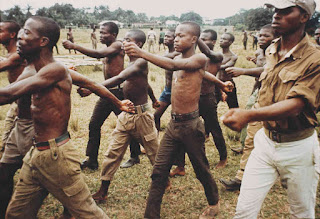
Young men training for the Biafran War. Image: Rolls Press Popper foto/Getty, August 1968 BY EMMANUEL IDUMA In 1967, Nigeria had been an independent country for just seven years. The declaration of secession that year by an Igbo majority in the southeastern region of Nigeria, and the war that followed when the federal government decided to keep the country as one, was already the culmination of a bloody sequence of events. By May 1967, two coup d’états had taken place, and the Igbos of northern Nigeria had been killed in the tens of thousands. The Biafran War, otherwise known as the Nigerian Civil War, lasted from July 6, 1967, until January 15, 1970. The men who led each side—Yakubu Gowon on the federal side and Chukwuemeka Ojukwu of Biafra—were in their mid-thirties. Boys, some barely teenagers, volunteered to fight for the breakaway Republic of Biafra. Many of the civilian casualties were children: in September 1968, the International Committee of the Red Cross estimated t...

We Ate Every Food As Our Last Supper Because Of Constant Air Raids – Ukaeje

Image
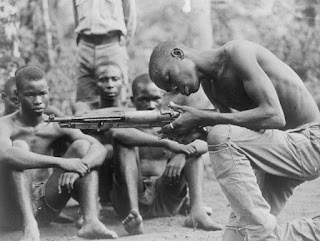
A young Biafran soldier inspects a rifle during training at camp in Owerri. After their initial training, the soldiers go to join the front line forces in Biafra's struggle against Nigerian federal troops. Image: Bettmann Collection. (July 1968) BY DAMIAN DURUIHEOMA Mr. Ifeanyi Ukaeje was on the verge of writing his senior school certificate examinations at Okongwu Memorial Grammar School, Nnewi when the civil war broke out. As the schools shut, Ukaeje enlisted in the Biafran Air Force where he worked as a protector of the Uli Airport. Although luck was on his side as he and the whole family survived the bloody 30-month civil war, he, like millions of survivors, went through horrible experience. The septuagenarian, who is also a veteran journalist, shares the story of his survival and other issues about the war with Damian Duruiheoma. Can you recall exactly where you were and how you found out that there had been an outbreak of war between the federal government and Biafra ? I...

I Lost My Father, Seminarian And Properties Worth Millions – EZEMA

Image
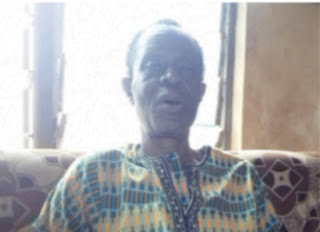
ORIENT DAILY INTERVIEW Image via Orient Daily News Paulinus Omeje Ezema was a 15-year-old boy in Ede Oballa community , Nsukka local government area of Enugu state when the Nigerian civil war broke out. The Ezema family fled their house when Nigerian troops captured Nsukka, leaving behind everything they acquired through the years. By the time the war was over, they lost everything, including their father . In this interview with Uchenna Ezeadigwe, the three-time deputy chairman of Nsukka East Development Centre and former councillor of Eduku Ward in Ede Oballa , Nsukka local government area, shares his incredible survival stories during the 30-month civil war, among other issues. Can you recall exactly when, where you were and how you found out that there had been an outbreak of war between the federal government and Biafra ? I was a teenager but not too young to remember what actually led to the civil war. The war was actually a fallout of the killing of the Igb...