Posts

'I looked for death but I couldn't find it,' a Nigerian town relives the brutal civil war, 50 years after it ended

Image
BY SHAYERA DARK Evelyn Okororie was a trader in Port Harcourt, southeast Nigeria before the civil war broke out. She lost three children in the war. Evelyn Okororie had just returned home from the market in Nigeria's Midwest region, when neighbors informed her that an airstrike had killed her mother, her niece and three of her children. The year was 1969, and it was two months before the end of the brutal two-year Nigeria-Biafra war, which killed an estimated one to three million people , mostly from the Igbo tribe in the eastern part of the country. It was said to be the world's first televised war and the haunting images of starving children caught in a civil war shocked the world. Protests were held around the world and Bruce Mayrock, a student at Columbia University, set himself on fire at the United Nations headquarters in New York to protest the war in Biafra. Beatles singer John Lennon returned his MBE in a protest over Britain's foreign policy, which included Bia...

BIAFRA: The Pogrom And Economic Blockade

Image
  A baby dies of malnutrition in the arms of a British nurse at Queen Elizabeth Hospital, Umuahia just one of the estimated one to two million victims of the Biafran War, on June 11,1968. Image: Ron Burton/Mirrorpix

INTERVIEW: How I Ran Central Bank Of Biafra – Sylvester Ugoh

Image
With participation in the Second Republic, General Ibrahim Babangida’s transition and the Peoples Democratic Party (PDP), he discusses the politics of Nigeria with relative ease. With the same candour, he talks on the Central Bank of Biafra, where he was the governor, explaining how he ran the two-man director institution for the 30 months the civil war lasted. Ugoh also dissects other issues in the land, identifying where the drift in the current democratic experiment commenced, as well as way out of the crisis. The last time many Nigerians heard about you was during the PDP Convention of 1999. Since then, you have literally been off the scene. Why? My wife was ill in the United States of America (U.S.), and my children, who were there, felt that I should come and stay with her because, usually, in the morning when they would have gone to work, she would be alone. It was not an easy decision for me to make. But considering her situation and how highly we regarded her, I decided to aba...

Asaba Massacre: Monument As Balm For War Trauma

Image
BY PIUS MORDI By all accounts, it was not a case of unfortunate collateral damage of war nor was the killing fields anywhere near the theatre of war. It was a premeditated and carefully planned murder. For the people of Asaba, October 7, 1967 is a day that lives in infamy. It was the day federal troops gruesomely slaughtered hundreds of their men and young men in one of the saddest chapters of Nigeria’s history and the first time mass killings of peaceful civilians were carried out in post-independence Africa. What came to be known universally as the Asaba massacre actually began a few days earlier on October 5, 1967 after Biafran forces were beaten back from their failed venture to capture Lagos at the onset of the civil war. Having been stopped on their tracks at Ore and a fast retreat ensued, federal forces entered Asaba on October 5 and launched series of deadly raids on homes to fish out and summarily execute any adult male they felt collaborated with the Biafran forces who had ea...

A Deleted Tweet, A Twitter Ban And Biafran Wounds That Have Never Healed

Image
BY BENJAMIN MAIANGWA AND OLUCHI CLORIA OGBU THE CONVERSATION The feeling of desertion by Nigeria’s federal government has not left the region that was defined as Biafra during the country’s civil war. Stefano Montesi - Corbis/Getty Images The Nigerian state is intricately laced with violent threads , woven into it by its colonial, military and ethnic setup. The Nigeria-Biafra war of 1967 to 1970 was both an outcome and a symptom of this configuration. This violent setup of the state is partly why the Biafran question remains an open sore . It has engendered heated activism in the country by groups like the Indigenous People of Biafra whose activism has often collided with the firepower of the state. The Igbos are one of three largest ethnic groups in Nigeria, situated in the southeast. Feelings of collective trauma and a lack of justice after the war have deepened their grievances and reinforced agitations for Biafra, which is both a contested geographic home for the Igbos and an ide...

BIAFRA: Corporal Nwafor And Souls Forgotten

Image
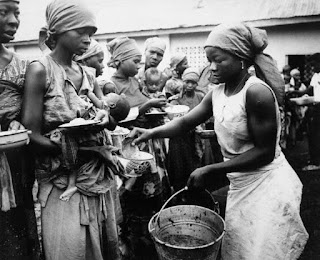
By all military odds, Biafra should have lost its war with the federal Nigerian vandals long ago. It has not lost, but in the next few months it might--vanquished by starvation. Here, women and children receive their meager rations at a refugee camp with some of their men lost in battle. Date: March 22, 1969. Location: Umuahia. Image: Bettmann Collection When Omieba Dan Princewill died in an air crash with Ibrahim Abacha and 12 others 24 years ago, a member of the Dan Princewill family was emphatic about keeping the apparel their son wore. That was to show that even in death the young man was brave. In 1968, Corporal Nwafor died, fighting for Biafra at Ugwu Nwasike, Ogidi. A captured Saladin Armoured vehicle was named after him. One remarkable thing was that during his funeral in Umuoji, a Nigerian Air Force bomber attacked the church. The officiating priest asked everyone to remain calm preaching that God would protect his children. The mourners obeyed. One man waved off ...

BIAFRA: Corporal Nwafor And Weeping Souls

Image
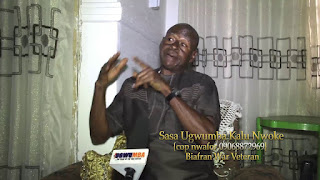
Sasa Ugwumba Kalu Nwoke. Image via Youtube There is an uncanny twist to the civil war which seems to blind those of us who should let the world know what really happened. I am talking about people from the former eastern region who were forced by genocide to become Biafrans in 1967. Sasa Ugwumba Kalu Nwoke was a class three student of the elite Government Secondary School, Afikpo, when the genocide began in 1966. Born into a comfortable middle-class home, his ambition was not to fight in any kind of war even if his Ohafia ancestors were warriors. A chance trip to the Enugu train station where he saw headless bodies and human parts brought in from Northern Nigeria turned him to a man. At school, he could neither bear the sorry sight nor console his junior, Nicholas Obasi. The boy’s father hid in a sack and watched as his pregnant wife was slaughtered in their Kano home. The foetus was not spared. At 16 years on January 28, 1968, Sasa forced his way into the Biafra Army...